

Custom Business Applications
When standard automation solutions no longer meet your requirements, we develop custom business applications tailored to your specific business needs. Thanks to such solutions, we can integrate systems and create internal business tools that operate according to your organisation’s logic.
What Do Custom Business Applications Mean in Practice?
Many organisations initially rely on standard tools such as CRM systems, project management platforms or workflow tools. While these tools are useful, they are often designed for generic use cases and cannot fully reflect the operational logic of a specific organisation.
As operations become more complex, organisations often need systems designed specifically for their internal processes. Custom business applications allow companies to connect existing platforms, automate workflows and manage operations within one integrated environment.
Using custom business software, organisations can connect different platforms and ensure that operational processes run automatically within a unified hyperautomation system.
When Companies Move to Custom Business Applications
In most cases, companies start with standard tools – CRM, project management platforms, or other business process software solutions. However, as the business grows, situations arise where these tools are no longer sufficient. Here are a few examples:
- processes run across several different systems that do not automatically exchange data;
- different departments work with separate platforms, resulting in fragmented information;
- internal processes are too specific for standard business process management software;
- the organisation needs internal systems that are simply not available on the market.
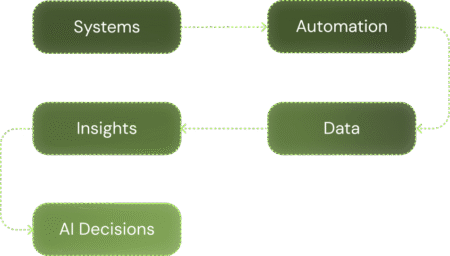
Within a hyperautomation architecture, Custom Business Applications provide the operational systems where work takes place. Workflow Automation manages process execution, Automation & Reporting collects operational data, and Power BI & Management Intelligence transforms this data into insights for decision-making.

Power Automate

Power Apps

Power BI

How We Build
Custom Business Applications
1. Process Analysis
First, we analyse existing business processes, systems used, and data flows. We identify where standard tools no longer meet real needs and what custom business software solutions could optimise processes.
2. System Architecture
We create the system architecture – i.e., how new custom business applications will work together with existing platforms or how they will replace them.
3. Custom Enterprise Software Development
We develop custom enterprise software tailored to specific business processes. This can include internal CRM solutions, operations management platforms, or other custom operational systems that support the daily activities of an organisation.
4. Integration & Automation
We connect different systems and automate processes using custom enterprise software.
5. Testing & Optimisation
The system is tested in real-life situations and optimised if necessary. The goal is to create stable custom automation solutions that support the organisation’s processes and can grow alongside the business.
The Impact of Custom Business Applications
-
Less manual work as custom business applications automate operational tasks and reduce the need for repetitive manual actions.
-
Clearer operational visibility. Internal, custom operational systems make it easier to monitor processes and understand how operations are performing.
-
Fewer errors. Automating processes reduces mistakes caused by manual data entry or fragmented tools.
-
Faster workflows. Business automation software solutions help processes move automatically between departments and systems.
-
Scalable operations. Such digital business tools allow companies to grow operations without proportionally increasing administrative work.
-
Better system integration. Custom applications allow organisations to connect CRM, finance, operations and other platforms into one integrated system.
Internal Business Systems We Can Build
Custom CRM systems
Customer service management tools
Invoice and finance management systems
Internal project management systems
Internal approval and workflow systems
Internal reporting dashboards
Operations management platforms
Document management systems
Inventory and order management systems
Employee onboarding systems
Sales pipeline management tools
Internal task management systems
Ready for Custom
Business Applications?
Automation & Data Audit will help identify where custom business applications, custom enterprise software, or other custom automation solutions could improve your business.
Not sure whether your processes require customisation or standard tools? Our team can review your workflows and recommend the most suitable approach before implementation.
FAQ
Custom business applications are individually developed business systems tailored to specific organisational processes. Unlike standard tools that are suitable for everyone, custom enterprise software is developed based on the actual activities of a specific company: how information flows, how teams work, and what data needs to be visible.
Such systems can be used for a variety of purposes: from internal workflow systems to project management, customer service, or financial operations management. For example, a company may have a specially designed system that automatically combines CRM, finance, and project management platforms into a single operating environment. Thus, custom business applications often become the internal operational infrastructure of an organisation – a system in which employees manage daily processes and management can see real business indicators.
Companies usually start considering custom business application development when standard tools already available on the market can no longer cover all processes. This often happens as an organisation grows, operates in a specific niche, or processes become more complex.
For example, different departments may use different systems, but they do not exchange data automatically. In such situations, a lot of manual work is required: employees transfer data between systems, prepare reports, or check information manually. In such cases, business automation software solutions are created that connect different platforms and allow processes to function as a single structure. This helps reduce administrative work and creates a clearer operations management system.
Power Apps is a low-code platform that allows you to create internal business applications using visual tools. It is often used for basic enterprise automation systems, such as internal registration forms and simple operations systems.
Custom business software, on the other hand, refers to a fully customised solution that can be adapted to more complex business processes, integrations, and data structures. Such systems can function as the central operating system of an organisation.
Workflow automation software is software that allows you to automate processes within an organisation. In such systems, tasks, documents, and data automatically move between different people or systems according to predefined rules. For example, when a customer submits a request, the system can automatically create a task for the responsible employee, transfer the information to the CRM, and start the proposal preparation process. In this way, the automation workflow runs without manual intervention.
Business process automation software is technology that allows you to automate your organisation’s business processes. Such systems can automate data transfer between platforms, document management, report generation, or task distribution.
Unlike individual automation tools, business process automation platforms often combine several functions: process management, integration, and data analysis. In practice, such systems are often integrated with CRM, ERP, or other business platforms so that organisations can automate operations and better manage data flows.
The development of custom business applications usually begins with an analysis of the organisation’s processes. First, they figure out how processes currently work, what systems are used, and where most of the manual work happens. Next, they build the system architecture, figuring out how the new custom business software will integrate with existing platforms, what data will be used, and what processes will be automated.
Once the planning stage is complete, custom business software development begins, during which applications, integrations, and automated processes are created. In the final stage, the system is tested and gradually implemented in the organisation so that employees can use it in their daily operations.
Standard automation tools, such as Zapier, Make, or other simple integration solutions, are usually designed to automate individual tasks or simple processes. They work great, but only in smaller systems or when you need to connect a few platforms.
However, in larger organisations, processes often become more complex: several different systems are used, processes span multiple departments, and data structures become complex. In such situations, simple tools can no longer effectively manage the entire process architecture.
In such cases, custom business applications are developed to connect different systems, create internal workflow systems, automate processes, and manage operations within a single platform. This enables organisations to build a stable foundation of business automation software solutions tailored to their specific business processes.