

Hyperautomation Framework
From Systems to
AI-Driven Decisions
Hyperautomation integrates the systems, automation and data used within a company into a single operational logic. Once an automation solution has been integrated, a CRM query, a change to an ERP record or a sensor reading can trigger the next step in the process.
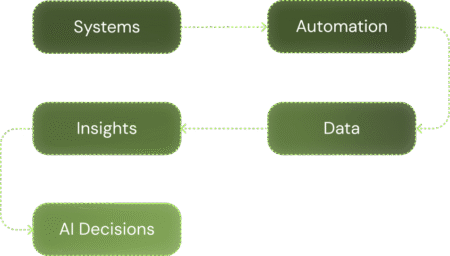
Companies generally do not lack systems, but rather the connections between them. Systems → Automation → Data → Insights → AI Decisions – these are the links that enable information from one system to flow into an automated process, combine with other data and, according to predefined rules, form the basis for AI Decisions.
AutomationCore designs and implements these connections so that systems, workflows, operational data and AI agents operate as one coordinated environment.
How Systems and
Automation Work Together
Hyperautomation solutions start where the day-to-day operations of a business already take place: these may include systems like CRM, ERP, financial platforms, SharePoint, Microsoft 365, internal applications, documents or databases. The operational systems form the basis of the system integration architecture, as they generate queries, records, documents, statuses and other information required for business operations.
Workflow and process automation determine how this information is handled next. It can assign a task, update related records, collect documents, initiate approval or notify the person responsible. Therefore, the intelligent automation framework links actions across systems and prepares data for further analysis.

Power Automate

Power Apps

Power BI

From Traditional Automation
to Hyperautomation
Traditional Automation
A single task or portion of a process is automated.
Data may remain in separate tools.
Employees still transfer some information manually.
An insight or report may be prepared separately.
Decisions are made outside the process.
Follows predefined logic
Hyperautomation
Several processes and the systems used in them are linked.
Information may flow between systems according to defined rules.
Automation passes the necessary context on to the next stage of the process.
Data and results may be viewed as a single operational overview.
AI Decisions can support the decision and initiate an authorised action.
Combines predefined logic with AI-based analysis and decision support.
How the Hyperautomation
Framework Works
This framework does not merely outline the stages of a given project. It helps to identify what should happen to information once it enters the system: whether it needs to be passed on, supplemented with further data, shown to the person responsible, or converted into a specific action.
Systems → Automation → Data → Insights → AI Decisions – this sequence links the actions into a single logical flow. Systems record what is happening in the business. Automation transfers information or initiates the next step in the process. Data combines context from different sources, whilst Insights enable us to understand what that context means for the organisation.
Only then can AI Decisions take over: to prepare a proposal, initiate a permitted action, or assess defined conditions. AI can support or perform these actions within defined permissions and operational boundaries, but its decision is based on information from the preceding layers. AI is not a separate add-on to the process – it is an integral part of the operational environment.

How Do Data, Insights and AI Decisions Work Together?
Management insights
Management insights and operational intelligence make it possible to see more than just an individual metric; they reveal its connection to the relevant process, the person responsible or the business priority. Decision intelligence combines historical patterns, real-time operational data and forecasts to support better operational decisions.
Integrated data
Enterprise data integration can combine information from CRM, ERP, documents, databases, sensors and external sources. Data orchestration and data consolidation help to transform individual records into unified operational data, which can be analysed within a single operational context.
AI decisions with boundaries
The AI decision layer can generate a decision proposal, supplement information or initiate an authorised action. AI agents must operate in accordance with defined access levels, permissions and human approval points; therefore, hyperautomation with AI agents does not imply uncontrolled automation.
Data Integration Architecture
For hyperautomation to transfer not only a task, but also the context required for a decision, data must be consolidated into a single view. This is exactly the role of the Data layer. The data integration architecture links data from multiple sources – internal system records, documents and database entries; real-time operational data from equipment or sensors; and changing external data sources, such as market prices, weather forecasts or data from other systems.
When required by the process, IoT integration, IoT data integration and sensor data integration incorporate information from physical equipment into this picture. Data unification and automated data pipelines help to prepare this data so that the next stage in the chain – Insights – is based on the current situation, rather than on isolated, unrelated fragments.
An Example of Hyperautomation in Practice
To show how Systems, Automation, Data, Insights and AI Decisions can work together in practice, let’s look at an energy operations scenario.
When deciding how to use the available energy, a single metric is not enough. A comprehensive overview is needed, including the building’s current energy consumption, real-time energy generation, current and forecasted electricity market prices, upcoming weather conditions, scheduled production start and end times, and other factors that may influence energy demand and availability in the near future.
-
Initial information is provided by operational systems: the building’s energy consumption, solar generation, battery storage charge levels, electric vehicles and charging points, as well as scheduled production start and end times.
-
Data integration combines this information into a unified operational view, allowing individual metrics to be analysed collectively rather than in isolation.
-
This is supplemented by IoT sensor data, historical operational and energy consumption data, and real-time external information, including current and forecasted electricity market prices, weather forecasts and warnings of potential disruptions.
-
By analysing historical patterns alongside real-time data and future forecasts, the system can predict energy generation, consumption and demand, anticipate changes in operating conditions, and evaluate different energy management scenarios.
-
Based on this comprehensive analysis, the system can determine the most efficient and cost-effective way to manage available energy: whether to use it immediately, store it for later, maintain reserves, export it to the grid or allocate it to electric vehicle charging. These decisions also account for upcoming production schedules, expected energy demand and anticipated electricity prices.
-
An AI decision support system can recommend or initiate actions in accordance with predefined rules and operational constraints. Low-risk actions can be executed automatically, while more significant decisions can be submitted for human approval.
How AI Agents Fit into Hyperautomation
AI agents are not standalone chatbots operating separately from business systems. Within a hyperautomation environment, they work on top of the Systems, Automation and Data layers, using the information, workflows and permissions already available across the organisation.
Systems provide the operational context, such as CRM records, ERP data, documents, production information or equipment status. Automation connects these systems and moves information between them, while the Data layer combines relevant internal, historical, real-time and external data into a unified context.
AI agents use this context to perform more advanced tasks: they can find and interpret information, prepare documents, analyse situations, recommend the next step or initiate an authorised action. Because they operate within predefined access rights, business rules and approval points, they can support or execute processes without acting outside the boundaries defined by the organisation.
In this way, an AI agent becomes part of the operational process rather than a separate conversational tool. It can work continuously across interconnected systems, respond to events and data changes, and help move a process from information to decision and action.
Where to Start with
Hyperautomation
To implement hyperautomation in your business, there is no need to overhaul your entire technological environment. Often, the first step is a single key link between systems, data and a solution, which can then be scaled where it delivers the clearest operational value.
FAQ
Here are a few situations where hyperautomation can be deployed:
- Customer service. An AI agent can read a query, find relevant customer, order or contract information in the CRM and documents, check the latest data via an external API, and draft a response. If the situation does not comply with the set rules, it is forwarded to a specialist rather than being resolved automatically.
- Document and financial processes. Upon receipt of an invoice or other document, the system can extract the necessary data, compare it with the order, contract or ERP records, and route the document to the appropriate approval workflow. This means that people are only involved when the data does not match or when the decision requires their approval.
- Operational decisions. In the energy sector, which we have already discussed, this might involve deciding what to do with the available energy, taking into account consumption, generation, the status of storage facilities, electricity prices and forecasts. In another sector, the same logic can be applied when planning capacity, priorities or actions based on the actual situation.
A key feature of hyperautomation is that systems do not merely pass on information or perform a single task. They create the context for the next step in the process and allow us to define in advance what can happen automatically and what needs to be handed over to a human.
- Less manual transfer of information, as data can flow between interconnected systems, meaning it does not need to be repeatedly searched for, copied or sent by email.
- More context when making decisions. People and systems can draw on relevant information from multiple sources, rather than a single isolated record.
- Clearer process flow and accountability: it is determined in advance which actions can be carried out automatically and when a decision needs to be handed over to a human.
- To implement hyperautomation, it is not necessary to change all processes at once. You can start with a single connection or process where fragmented data is causing the greatest delay.
Hyperautomation connects the systems and data involved in a process, then uses that shared context to support the next step. Automation moves information between systems, while AI can assess the available data and take or recommend an action within predefined rules. More significant decisions remain with the people responsible for them.
The key elements of hyperautomation are as follows:
- Systems where operational activities are performed and the data required to support business processes is stored and managed.
- Automation – connections and workflows that transmit information and initiate actions between systems.
- Internal, historical, real-time and external data combined into a single context.
- Insights – the analysis of data to help understand the current situation and possible courses of action.
- AI Decisions – the next step in the process is prepared, recommended or initiated within defined limits.
Data integration combines the information required to make a decision, from systems, documents, databases, sensors and external sources. Automation or AI can then operate based on all the necessary context, rather than on a single record or a manually prepared report.
Yes. Real-time operational data is particularly important when the next action depends on the current status of equipment, energy consumption, production or another process.
AI agents can use the context of interconnected systems and data to find information, prepare a document, suggest the next action or initiate an authorised part of a process. Their access rights, permitted actions and points requiring human approval are determined based on the risk and significance of the specific process.
Start with a process where information is constantly being transferred between several systems, or where decisions are delayed because data is fragmented. The first step is to identify which systems already hold the necessary data, what can be automated, and where a human must make the decision.