

Automated Reporting
Automated reporting allows organisations to move away from manual reporting and build an automated data collection and reporting infrastructure. Instead of manually preparing reports from multiple systems, companies can create automated data pipelines that continuously gather and structure information. In hyperautomation architecture, automation & reporting collects and prepares data, making it visible and ready for further analysis.
What Is Automated Reporting?
Automated reporting refers to systems that automatically collect, process and prepare operational data for reporting and analysis. Instead of employees periodically collecting information from different systems and preparing reports, automated reporting systems create automated data flows that continuously collect and structure information.
In practice, automated reporting tools work by connecting different business systems – CRM, financial platforms, project management tools, or other operating systems – and creating automated data pipelines between them. These automated reporting pipelines allow data to automatically move between systems, be connected, and be prepared for further reporting.
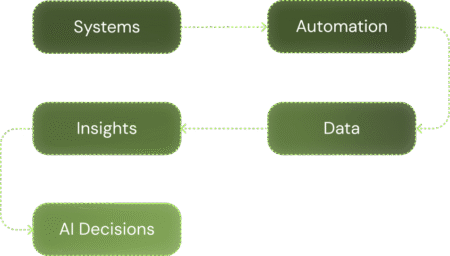
Where Automated Reporting Fits in Hyperautomation
Automation & Reporting represents the data infrastructure layer of hyperautomation. For example, Workflow Automation automates business processes themselves – tasks, document movement or actions between systems. Custom Business Applications create internal systems and platforms where these processes take place and where business data is generated. Automation & Reporting acts as an intermediate layer between operating systems and analytics. The data collected through Automation & Reporting systems is then used by Power BI and other analytics tools to create management dashboards and performance insights.

Power Automate

Power Apps

Power BI

How We Implement Automation & Reporting Systems
1. Process & Data Analysis
First, we analyse the systems, data sources, and reporting processes used by the organisation. We assess where the data comes from, how it is currently collected, and where manual work occurs that could be replaced by automated reporting tools. We determine which data automation solutions can automate data collection.
2. Data Integration & Automation
We connect different business systems and create automated data flows. Such automated data pipelines allow data to move automatically between systems.
3. Automated Reporting System Development
We apply automated reporting software solutions that allow you to automatically generate business reports. This can be automated business reporting, automated client reporting, automated financial reporting, or other automation solutions.
4. Testing & Optimisation
The created automated reporting system is tested in a real environment. We optimise data models, automated reporting flows, and integrations to ensure that the automation business process operates stably.
The Impact of Automated Reporting
-
Less manual reporting work. Automated reporting software can eliminate repetitive report preparation and reduce the need to manually collect data from multiple systems.
-
Real-time operational reporting allows organisations to monitor operations, finance and performance continuously instead of relying on periodic reports.
-
Clearer operational visibility. Automated data reporting combines data from different platforms and creates a structured view of business activity.
-
Improved data reliability as automated pipelines reduce the risk of human error in reporting.
-
Scalable reporting infrastructure. An automated reporting system can support growing data volumes and allow organisations to expand reporting capabilities without increasing manual work.
Data Automation Solutions We Build
Automated financial reporting
Automated compliance reporting
Revenue performance reporting
Automated client reporting
Automated operational reporting
Supply chain reporting automation
Automated business reporting
Executive control dashboards
Inventory reporting automation
Automated regulatory reporting
Real-time operational reporting
Customer reporting automation
Ready to Automate
Your Reporting?
Automation & Data Audit will help you understand how your organisation currently collects and prepares data for reporting. We will assess your existing systems and identify where automated reporting systems, data automation solutions, or business reporting automation could eliminate manual reporting work and improve operational visibility.
FAQ
Business reporting automation usually starts with an analysis of processes and data sources. Organisations often have data in different systems, so the first thing to consider is process automation solutions that connect these data sources. Such systems usually use process automation software that allows you to automate data collection, processing, and report generation. The result is business reporting automation, where reports are generated automatically, rather than manually.
Automated reporting is the process of automatically collecting, processing, and reporting business data without manual intervention. Using automated data reporting solutions, organisations can move from manual reporting to real-time automated reporting, where business metrics are constantly updated without the need for manual input.
Automation and analytics are usually connected through data infrastructure, or more specifically, dedicated platforms. Automation creates structured data streams, and analytics platforms can transform them into automation-driven insights. Such an architecture allows organisations to move from fragmented data to a clear analytical framework.
Automated reporting solutions typically use specific process automation software that automates data collection, processing, and report generation. In large organisations, such systems often become part of a broader enterprise automation infrastructure, where reporting automation works in conjunction with other intelligent process automation solutions and data management tools.
Automated reporting usually works in conjunction with automated data flows. Such solutions use enterprise data automation and process automation solutions, which create automated data transfer channels between systems.
These data flows allow you to create a stable automated data reporting process, in which information from different platforms is constantly updated and prepared for reporting and analytics.
Reporting can be automated in a variety of business areas. Some examples include enterprise invoice automation, which allows for the automatic collection of financial data from accounting systems, and enterprise document automation, which helps automate document data collection. Email automation workflows, customer reporting processes, or operational data flows are also commonly automated.
Yes, automated reporting is often used to automate financial and regulatory reporting. Such systems use automated financial reporting software, which allows you to automatically generate financial reports from accounting or ERP systems. Automated solutions can also help with the regulatory reporting process – data is collected automatically, which reduces the risk of errors and simplifies compliance processes.
Automation allows organisations to move from fragmented data to a clear operational information structure. Using enterprise automation and business reporting automation, organisations can constantly see the most important business indicators and to present them without requiring manual involvement. Such systems help solve data chaos management problems – data from different systems is combined and becomes easier to analyse.